
The Ultimate O General AC Engineering & Architectural System Specification Manual
In the United Arab Emirates, air conditioning is not merely a residential amenity—it is the vital mechanical engine that guarantees structural habitability, indoor air quality, and environmental safety.
Operating under the 2026 regulatory framework defined by the Ministry of Industry and Advanced Technology (MoIAT), Dubai Municipality’s Al Sa’fat Green Building System, and regional utility compliance standards (DEWA, ADDC), choosing and engineering an HVAC infrastructure requires strict technical analysis. This exhaustive guide provides property owners, facility directors, and MEP contractors with an authoritative breakdown of thermodynamics, high-ambient compressor dynamics, structural heat-gain physics, and comparative equipment architecture across Dubai, Abu Dhabi, Sharjah, and the Northern Emirates.
Module 1: The Thermodynamics of High-Ambient Tropicalized Cooling (55°C T3 Testing)
Most global air conditioning machinery manufactured for Western or temperate European climates is validated under Standard T1 testing parameters, where outdoor testing temperatures peak at 35°C (95°F). In the Arabian Gulf, however, peak summer shadow temperatures regularly surpass 48°C, while localized heat islands—created by dark asphalt roads, concrete roof slabs, and metallic architectural cladding—drive condensing ambient temperatures above 52°C to 55°C.
When a T1-rated air conditioner operates in ambient heat exceeding 42°C, the temperature differential ($\Delta T$) between the hot condenser coil and the surrounding air shrinks dramatically. According to the Second Law of Thermodynamics, heat transfer rates drop proportionately. As a consequence, high-side system pressure rises, causing standard compressor motors to draw excessive amperage, overheat, and trip their internal thermal overload protection. The system enters a cycle of thermal stalling, resulting in a 30% to 50% drop in sensible cooling output precisely when indoor spaces require maximum capacity.
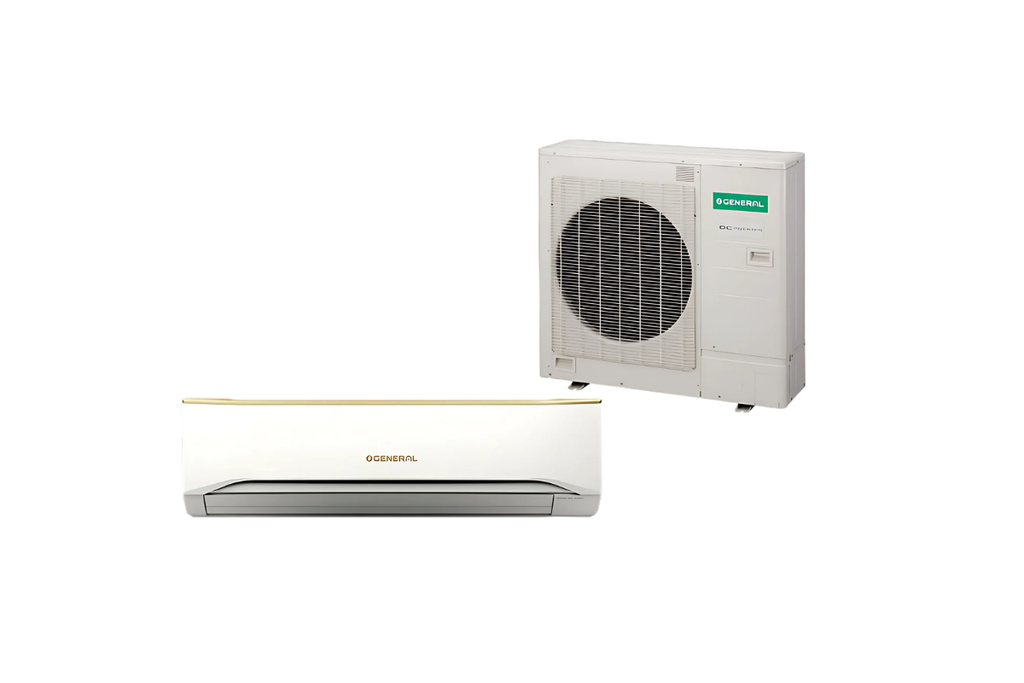
To withstand these extreme conditions, O General equips its Middle East commercial and residential lineup with certified T3 High-Ambient Compressors. Engineered specifically for continuous operation at 55°C (131°F), these systems incorporate key mechanical upgrades:
1. Advanced Synthetic POE Lubrication Film
Standard mineral oils break down and thin out under sustained high-pressure heat, leading to friction wear on internal scroll surfaces and rotary vanes. O General uses high-viscosity Polyolester (POE) synthetic lubricants that maintain protective film integrity even under severe thermal shear.
2. Class-H Insulated Heavy-Duty Motor Windings
Compressor motor stator windings utilize high-grade Class-H copper insulation. This construction resists dielectric breakdown during continuous heavy electrical loads, ensuring long coil lifespans under non-stop summer operation.
3. Expanded Sub-Cooling Heat Exchanger Circuits
Condenser coils feature extended sub-cooling passes that ensure 100% liquid refrigerant reaches the expansion valve without premature flashing. This maximizes cooling capacity per pound of circulating refrigerant.
4. High-Static Axial Fan Aerodynamics
Outdoor condensing fans use wide-sweep, high-static pitch blades driven by multi-speed DC motors. This ensures rapid heat dissipation even when condenser coils face restrictive architectural louvers or tight roof parapets.
Module 2: Thermal Load Physics and Precision Sizing Calculations
Applying crude floor-area rules of thumb (such as assigning a blanket 1 Ton per 100 sq. ft.) is one of the most common causes of HVAC failure in UAE properties. In modern architectural designs across Dubai Marina, Downtown, Palm Jumeirah, and Emirates Hills, floor area represents only one component of the total thermal equation.
A complete HVAC specification requires calculating both Sensible Heat Gain (dry thermal radiation through building envelopes and internal electronics) and Latent Heat Gain (moisture introduced by human occupancy, cooking, and fresh-air ventilation).
| Architectural Typology | Primary Thermal Vectors | Baseline Tonnage Guidance | Engineering Correction Factors |
|---|---|---|---|
| High-Rise Glass Curtain-Wall Bedroom | Unshaded solar radiation, high glazing $U$-value | 12,000 BTU / 1.0 Ton | Add +25% for West/Southwest glazing orientations |
| Duplex/Villa High-Ceiling Lounge | Extended room height, roof slab conduction | 24,000–30,000 BTU / 2.0–2.5 Ton | Calculate total cubic air volume ($m^3$) rather than floor area |
| Residential Majlis / Entertainment Room | High intermittent occupancy, frequent entrance activity | 36,000 BTU / 3.0 Ton | Add 600 BTU/hr per additional occupant above 6 people |
| Commercial Kitchen / Dining Area | Thermal cooking equipment, fresh air makeup intake | Custom Psychrometric Profile | Must balance mechanical exhaust air rates with conditioned fresh makeup air |
Critical Engineering Risk: Oversizing an air conditioner leads to short-cycling—where the unit cools the room temperature so fast that the compressor turns off before extracting relative humidity. This leaves indoor spaces feeling cold and clammy, encouraging mold growth. Conversely, undersizing keeps the compressor running continuously at maximum frequency, accelerating mechanical wear and driving up DEWA utility bills.
Module 3: Equipment Architecture: Wall Split vs. Concealed Ducted vs. VRF
Selecting the right system architecture establishes the ideal balance between interior design preferences, initial capital cost, and ease of ongoing maintenance.
1. High-Wall Split Systems
Ideal Applications: Individual studio apartments, maid’s quarters, localized room additions, and budget-conscious villa retrofits.
Wall splits do not require ceiling ductwork, allow independent temperature control per room, and feature simple maintenance access. However, indoor wall units remain visible, and multiple outdoor condensers require dedicated balcony or wall-bracket space.
2. Concealed Ducted Systems
Ideal Applications: Luxury residential villas, master suites, open-plan reception rooms, and premium office spaces.
Fan coil units (FCUs) are hidden above gypsum false ceilings, delivering conditioned air quietly through architectural linear slot diffusers. Ducted setups require precise duct static pressure engineering, double-density acoustic insulation, and strategically placed ceiling access hatches for maintenance.
3. Variable Refrigerant Flow (VRF)
Ideal Applications: Large luxury estates, commercial compounds, multi-story office buildings, and boutique hotels.
VRF systems connect a single modular outdoor condensing unit to dozens of indoor units (ducted, cassette, or wall-mounted) via a shared refrigerant piping loop. This drastically reduces the roof space needed for outdoor units while maximizing energy efficiency through variable-speed operation.
Consult with Optimus General’s MEP Engineering Team
You have reviewed the thermodynamic standards, heat-load principles, and system architectures for UAE HVAC projects. Ask for Part 2 to continue with technical installation protocols, copper vacuum evacuation, ductwork leakage standards, and coastal anti-corrosion protection.