
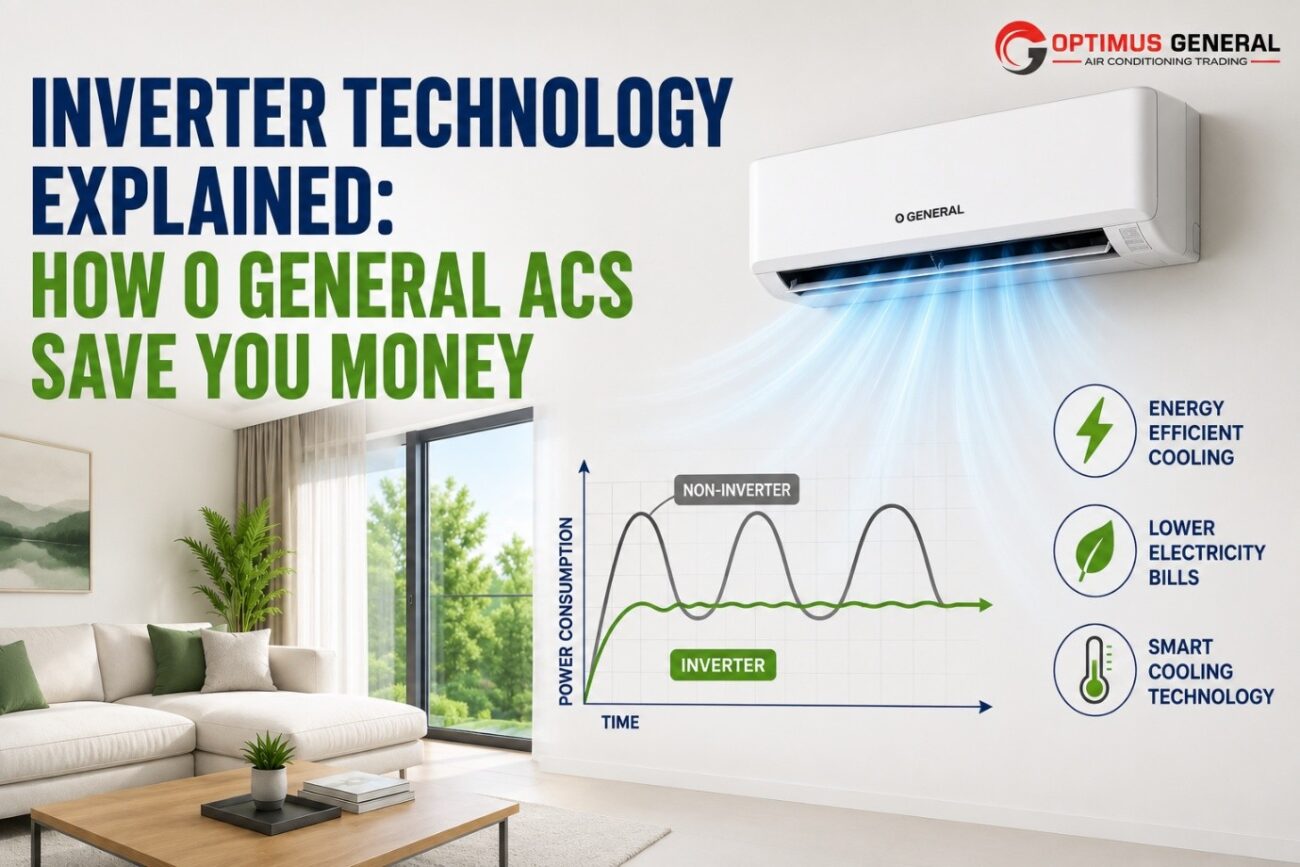
Inverter Technology Explained: How O General ACs Save You Money
The UAE’s 2026 HVAC market operates under punishing summer loads, tighter appliance-efficiency controls, and delivery schedules that leave little room for specification errors. Inverter AC Technology addresses this operating reality by varying compressor output instead of repeatedly switching between full power and shutdown. For villas, apartments, retail assets, and staff accommodation, that control method matters most during long cooling cycles, when outdoor temperatures approach equipment limits and electricity use accumulates hour after hour.
Variable-Speed Compression Changes the Cost Curve
A fixed-speed compressor reaches the thermostat setting, stops, and then restarts at full output when the room warms again. Each restart creates an electrical surge and a noticeable temperature swing. An inverter-driven compressor changes its motor speed through frequency control, delivering high capacity during pull-down and reducing output once the space stabilises. General’s technical material describes this variable-frequency principle and links it to stronger cooling control under changing loads.
That modulation supports energy-efficient cooling because the machine spends more time matching the actual heat entering the room. It does not remove the need for correct sizing. A 24,000 BTU unit installed in a small bedroom may cycle poorly, while an undersized unit serving a glazed majlis can remain near maximum speed throughout the afternoon.
High-Ambient Performance Must Come Before Savings Claims
Middle East product literature from General identifies inverter models verified for continuous operation at outdoor temperatures up to 55°C. That figure describes an equipment capability, not a typical daily weather reading. It matters because high condenser temperatures increase compressor pressure and reduce available cooling capacity if the outdoor section lacks sufficient heat rejection.
Owners seeking lower electricity bills should therefore assess the full installation. Shaded condenser placement, clean airflow, correct refrigerant charge, sound pipe insulation, and an unobstructed return-air path all influence operating cost. In Jumeirah and Ras Al Khaimah, salt exposure adds another requirement. Coastal projects need corrosion-resistant coil protection, coated metalwork, and maintenance access for regular freshwater cleaning.
Practical Capacity and Efficiency Screening
| Conditioned area | Indicative capacity | Typical UAE application | Cost-control check |
| 12–18 m² | 12,000 BTU | Bedroom or compact office | Review afternoon solar gain |
| 18–28 m² | 18,000 BTU | Main bedroom or study | Check glazing and occupancy |
| 28–40 m² | 24,000 BTU | Living room | Include open kitchen load |
| 40–55 m² | 30,000–36,000 BTU | Majlis or large family room | Complete a measured heat-load study |
These bands provide an early procurement screen only. Ceiling height, façade orientation, infiltration, insulation, and internal equipment can change the final selection.
Controls, Labels, and Real Household Behaviour
An O General inverter produces its best financial result when controls reflect occupancy. A stable 24°C setting usually performs better than aggressive thermostat changes followed by repeated recovery at maximum output. DEWA states that raising the setpoint by 1°C can save up to 5% of AC consumption. It also advises replacing older units with four- or five-star efficient models, which may reduce cooling consumption by up to 25%.
Buyers should still verify the registered model rather than relying on a showroom sticker. The UAE conformity system now sits under the Ministry of Industry and Advanced Technology, while “ESMA five-star” remains familiar trade language. Model registration, tested capacity, and seasonal operating performance carry more value than a generic efficiency claim.
Building Type and Logistics Can Alter Payback
Building type and logistics can alter the payback from smart cooling controls. In Downtown Dubai high-rises, ducted inverter systems may integrate with concealed ceilings, building-management controls, fire dampers, and restricted service zones. Poor duct sealing or excessive static pressure can consume part of the expected savings. Dubai Municipality requires air ducts to minimise leakage and calls for pressure testing where specified. In Sharjah & Ajman, the 48-hour replacement target requires confirmed stock, access approval, lifting plans, compatible electrical supply, and installation materials before dispatch.
Abu Dhabi offshore oil operations are a heavier capital model of redundancy, approved equipment lists, spares and harsh-environment protection. A residential buyer does not need that industrial specification, yet the same procurement discipline improves operating outcomes. Confirm duty conditions, service access, controls, warranty scope, and preventive maintenance before approving the purchase.
Final Perspective
Long-term savings come from matching inverter capacity to measured heat load, protecting outdoor equipment, and operating the system at a stable setpoint. DEWA’s guidance indicates that efficient replacement equipment can cut cooling consumption by up to 25%, while each 1°C thermostat increase may save up to 5%. Inverter AC Technology therefore offers a credible financial case when specification and installation support it. O General AC UAE welcomes requests for a corporate or residential consultation based on the property’s actual operating conditions.
FAQs
How does inverter AC technology actually reduce electricity bills?
Regular units cycle on and off at full power each time. Inverter compressors just throttle up or down instead, which means way less energy wasted on restarts. Over a full UAE summer, that difference shows up clearly on the bill.
Is O General inverter cooling worth the extra upfront cost?
Yes, the unit costs more on day one, sure, but lower monthly bills start closing that gap fast, especially running daily through UAE heat. Most homeowners break even well within a couple of cooling seasons.
How much can energy-efficient cooling save monthly in UAE heat?
Varies by home size and usage, but a noticeable chunk. Some households see bills drop by a meaningful percentage once they switch from an older non-inverter unit. Bigger homes running AC constantly tend to notice the savings fastest.
Does smart cooling technology require special home wiring?
No, standard household wiring handles most modern units fine. What might need attention is the circuit capacity if you’re upgrading from an older, smaller system. A quick check from an installer usually settles that before setup begins.
How long does an inverter AC unit typically last?
With decent maintenance, somewhere around ten to fifteen years is common. Filters need cleaning, servicing should happen yearly, and the compressor tends to hold up well since it’s not slamming on and off the way older units do.
Is inverter technology better suited for homes or offices?
Yes, homes benefit from steadier comfort and lower bills over time. Offices get the same perks plus quieter operation during work hours, since inverter units don’t cycle loudly the way older systems tend to.