
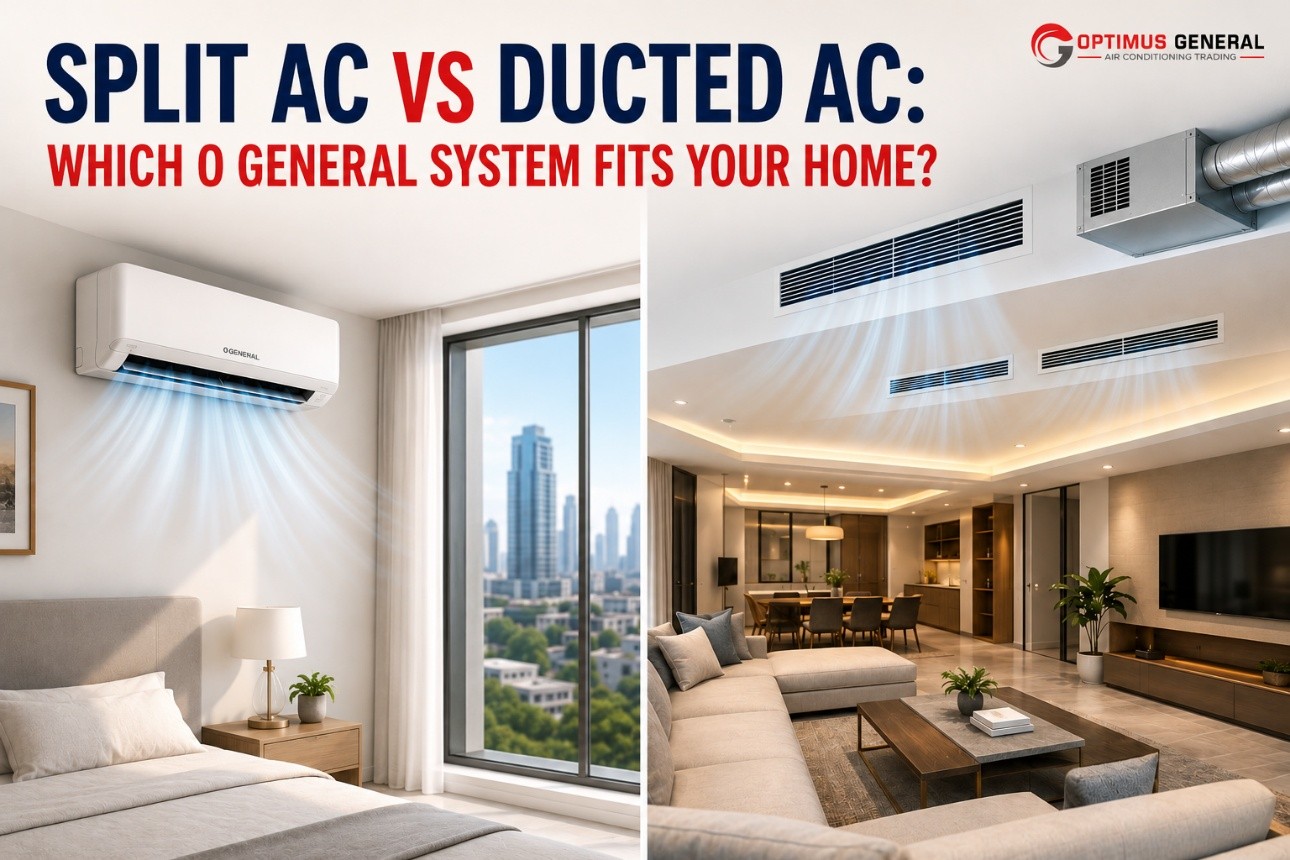
Split AC vs Ducted AC: Which O General System Fits Your Home?
The UAE’s 2026 cooling market is shaped by high-ambient equipment testing, tighter efficiency labelling, compressed delivery schedules, and building-specific installation controls. An O General Split AC suits many apartments and villas because it gives each occupied room independent capacity without a ceiling-wide air-distribution network. Yet the better investment depends on heat gain, glazing, occupancy, duct routes, electrical provision, outdoor-unit exposure, and the owner’s tolerance for maintenance disruption during the longest summer operating cycle.
The 2026 UAE Load Case Is More Demanding Than Nameplate Tonnage
UAE buyers should distinguish weather records from equipment capability. The practical procurement benchmark is whether a selected model can keep operating under extreme outdoor conditions, with some General inverter ranges verified for operation up to 55°C. Dubai Municipality’s published regulations base formal heat-load calculations on defined design conditions rather than casual room-size estimates. That distinction matters because west-facing glass, top-floor roofs, cooking loads, and frequent door opening can push residential cooling demand well above a basic square-metre formula.
Coastal placement adds another layer. Condensers serving homes in Jumeirah or Ras Al Khaimah face salt-laden air, so buyers should specify corrosion-resistant coil protection, accessible wash-down space, and drainage that does not leave brine residue around the base frame.
Where Wall-Mounted Splits Deliver the Stronger Business Case
A split arrangement works best when bedrooms, studies, and living areas run on different schedules. Owners can cool only the rooms in use, replace one indoor unit without opening several ceilings, and phase capital spending across a renovation. Under variable occupancy and thermostat conditions, a modern inverter AC also modulates compressor output as the room approaches setpoint, which reduces repeated full-load cycling and improves part-load control during evenings or shoulder months.
The visible indoor unit remains the architectural compromise. Long refrigerant runs, poor condensate falls, undersized cable, or a condenser trapped on a hot balcony can erase much of the expected performance. Ac Installation quality carries as much weight as the brand badge.
Indicative Capacity Tiers for UAE Homes
| Typical conditioned area | Starting capacity | Common application | Engineering caution |
| 12–18 m² | 12,000 BTU | Compact bedroom | Increase allowance for strong afternoon sun |
| 18–28 m² | 18,000 BTU | Main bedroom or study | Check glazing and ceiling height |
| 28–40 m² | 24,000 BTU | Living room | Review open-plan kitchen load |
| 40–55 m² | 30,000–36,000 BTU | Large majlis or family room | Require a measured heat-load calculation |
These ranges are screening figures, not final selections. Oversizing can create short cycling and weak humidity removal, while undersizing keeps the compressor near maximum output for long periods.
When Ducted Cooling Justifies the Higher Entry Cost
Ducted systems suit villas with coordinated ceiling design and premium apartments where owners want concealed grilles, balanced air throw, and one visual language across several spaces. In luxury Downtown Dubai high-rises, however, contractors must work around restricted ceiling voids, fire dampers, access panels, acoustic limits, building-management approvals, and sometimes district-cooling interfaces. These constraints can make otherwise attractive home AC systems expensive to alter after handover.
Duct quality is decisive. Dubai’s green-building rules require insulation for conditioned-air ducts and call for leakage control because escaping air raises fan energy use. Proper commissioning should verify static pressure, diffuser balance, return-air paths, condensate drainage, and service access before ceilings close.
Procurement, Efficiency, and Regional Response
- Efficiency label: Trade conversations still use “ESMA five-star,” although MoIAT now administers UAE energy-efficiency labels and published updated low- and large-capacity air-conditioner standards in 2025. Compare the registered model, test condition, and capacity, not the star graphic alone.
- Coastal specification: Ask for protected fins, coated fasteners, sound mounting, and a maintenance route that supports regular coil cleaning.
- Delivery planning: An energy-efficient AC ordered against a 48-hour Sharjah or Ajman requirement still needs confirmed stock, vehicle access, lifting arrangements, installation materials, and an approved crew. Fast dispatch without site readiness only moves the delay.
- Project scale: Abu Dhabi offshore oil operations require a different capital and compliance model from a home installation. Residential buyers should not pay for industrial redundancy, but they should borrow its discipline around spares, documentation, and preventive service.
Compare annual operating hours, zoning, duct losses, filter pressure, service access, and expected ownership period. Purchase price alone rarely identifies the lower-cost system.
Final Perspective
Choose a split layout for independent room control, phased replacement, and lower installation disturbance. Choose ducted cooling when architectural concealment, balanced distribution, and whole-zone control justify added design and commissioning cost. The strongest long-term investment starts with a measured load calculation, verified high-ambient performance, compliant efficiency documentation, and realistic service access. An O General Split AC remains the practical choice for many UAE homes, while O General AC UAE can also assess ducted requirements. Request a corporate or residential consultation when project-level guidance would help.
FAQs
What’s the real difference between an O General split AC and a ducted system?
One cools a single room, the other cools a whole house through vents. That’s the short version. A split unit sits in that room and does its job alone. Ducted systems hide the equipment away and pipe air to wherever it’s needed.
Is inverter AC better than a non-inverter split unit for daily use?
It depends on what you’re optimizing for. Inverter units cost more to buy but the compressor just eases up instead of shutting off completely, so the room stays steadier and the power bill usually ends up lower over months of use.
Which option offers better residential cooling for a UAE apartment?
Apartments rarely need ductwork running through the ceiling. A split unit or two handles most layouts fine, goes in faster, and costs less to install. Ducted setups start making more sense once you’re talking about a bigger footprint.
Do ducted home AC systems cost more to install than split units?
Yes, ductwork has to be built into the home itself, and that’s labor plus materials before the actual unit even goes in. Split units skip all of it, mount directly, and get running in a fraction of the time.
Which setup is more energy-efficient for large villas?
Once a home has several rooms needing steady cooling, one central ducted system can outperform a handful of separate split units working independently. Fewer compressors running means less wasted energy across a big villa.
Can you mix split and ducted units in the same home?
Yes, this happens more than people think. Ducted for the living areas, split units tucked into an extension or a bedroom that got added later. No rule says a home has to pick just one system and stick with it.